Tuesday, February 15, 2011

3-2-1.... BLAST-OFF?

William Wilberforce!
In this chapter, I learned that utilitarianism isn't about utilities or work, or anything like that. I learned that it is an idea that governments are only useful if they promote the greatest good for the greatest number of people. I also learned that blogs are fun! Well, just kidding on that last one, I already knew that blogs are fun! I actually learned that a man named William Wilberforce led the fight for abolition in Britain, AND that he didn't do it because it posed an economic threat, like some people believed, he opposed slavery because it was morally wrong. A third thing that I learned was that kids nine and up were allowed to work in factories, even after child labor "ended." Instead, they just worked a shorter day than everyone else. I don't really agree with this, but then again, I wasn't alive during that time period, so I have no idea what it would be like.

I found a couple of things interesting about this chapter as well. For instance, I thought that it was interesting that the Agricultural Revolution was followed immediately by the Industrial Revolution. I guess it was coming, but I didn't realize that they were actually that close together! I also found the ideas of Karl Marx pretty interesting, especially when I read the History of Western Philosophy, but that might have been because I learned cool terms like "dialectical materialism" and "dialectical idealism" (basically, I like the sound of the word "dialectical"). I also found his idea of this utopian society that we should always strive for. I like that he focused on that.

The only question I have left is about how industrialization spread through other areas of the world. I found this chapter to be really interesting, and it left me wanting to know more about industrialization and its effects on society. Not only did it make things easier, it changed the way people thought, and I think that something that can change the way that people think is worth knowing more about.

Communism Today

Communism is a form of total socialism in which everything is shared equally by the people. Private property is obsolete in a communist society. This was developed based on the belief that social classes would eventually tear the world apart. Communists believe in social equality amongst the people and classless society. Today, Communism exists in countries such as People's Republic of China, Vietnam and North Korea.


Above is an image of North Korea, a nation that still uses communism today.


Factory Act of 1833

To the twenty-first century teenage, child labor is a difficult concept to grasp. Sure, children of this generation have had to do chores here and there, but nothing that compares to child labor (although many "smart" kids have tried to get out of them by informing their parents that child labor is illegal...) as children of the Industrial Revolution know it. This reform was the law that made child labor in Britain illegal. It mandated that it was illegal to hire anyone under the age of nine, that children nine through twelve years of age were only allowed to work eight hours a day, and that those from thirteen to seventeen could work no more than twelve hours in a day. 


(Lewis Hine captured the horrors of child labor extremely well.)

Connection Across Time: The iPhone

Steve Jobs, along with the rest of the apple development team came up with the iPhone concept in 2005. This phone revolutionized mobile technology. Although smart phones were available prior to this development in cellular technology, this placed more of an importance on cellular technology. 
On any given day, in any given high school cafeteria, at any given table, one can hear discussions about cell phone quality. The iPhone forced Blackberry to improve, and, in turn, influenced the Android phones and many other smart phones. This changed the way that people get information and the amount of technology that they use in their everyday lives.

Spinning Mule

In 1779, Samuel Crompton developed his plan for a machine called the spinning mule. The spinning mule was like a cross between a spinning jenny and the water frame (developed by Richard Arkrwight) and set out to fix the problems of the two. The spinning mule also spun cotton into yarn or thread, but the mule produced a material that was substantially stronger and more durable than those produced by other methods. Crompton, like Hargreaves, used multiple spindles to produce multiple threads at once. This invention was extremely successful because it further improved the textile industry and was utilized for years to come.

Spinning Jenny

The spinning jenny was invented in 1764 by James Hargreaves. This invention also dealt with the textile industry, like the cotton gin. This invention revolutionized the process of spinning yarn. Instead of being able to simply spin one spool of yarn at a time, the spinning jenny allowed spinners to spin 8 spools at once. (This number later grew to 120 spools, as technology advanced further.) At this point in history, the demand for cotton was much greater than the supply, and thus James Hargreaves improved the production of yarn to keep up with the cotton industry.

Monday, February 14, 2011

Mr. Whitney and His Cotton Gin


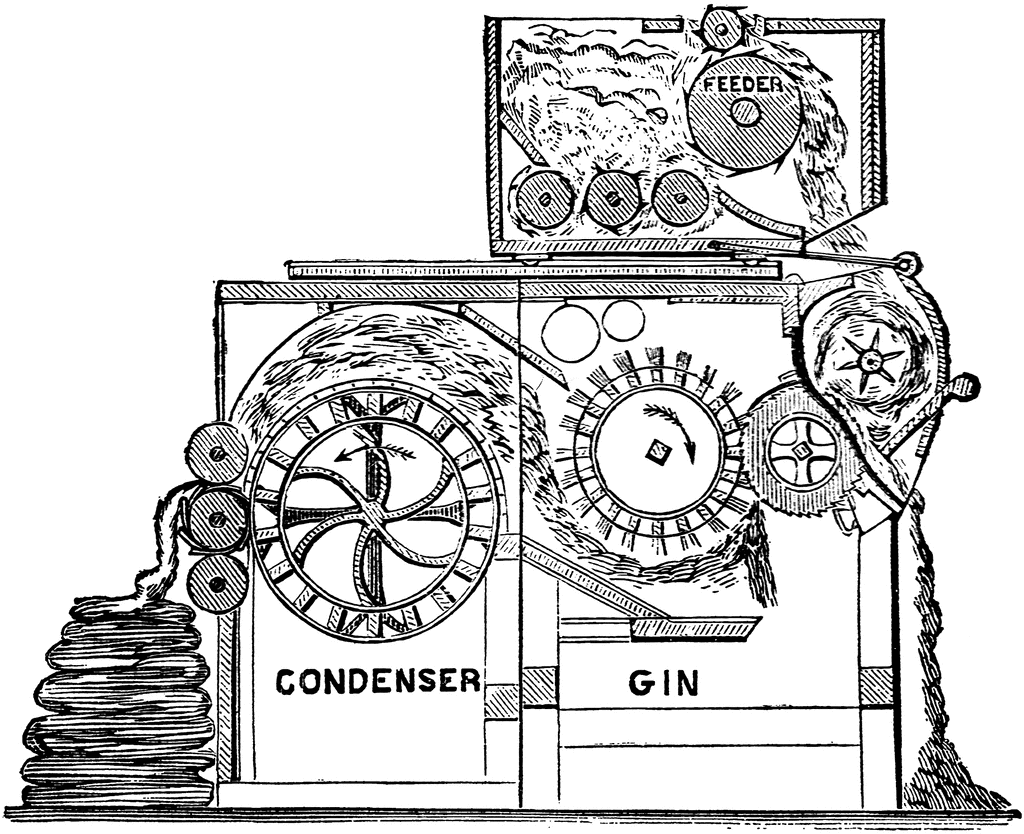
The cotton gin, or cotton engine, was invented in 1793 by Eli Whitney. This invention revolutionized the entire industry. Before this machine was invented, cotton seeds had to be picked out by hand. This task was extremely time consuming and often somewhat ineffective. Basically, the gin used teeth to comb the cotton and separate the seeds from the usable fibers. The cotton gin allowed much more cotton to be cleaned in a much faster way. Cotton production skyrocketed because of the convenience of this machine and the speed with which it worked.